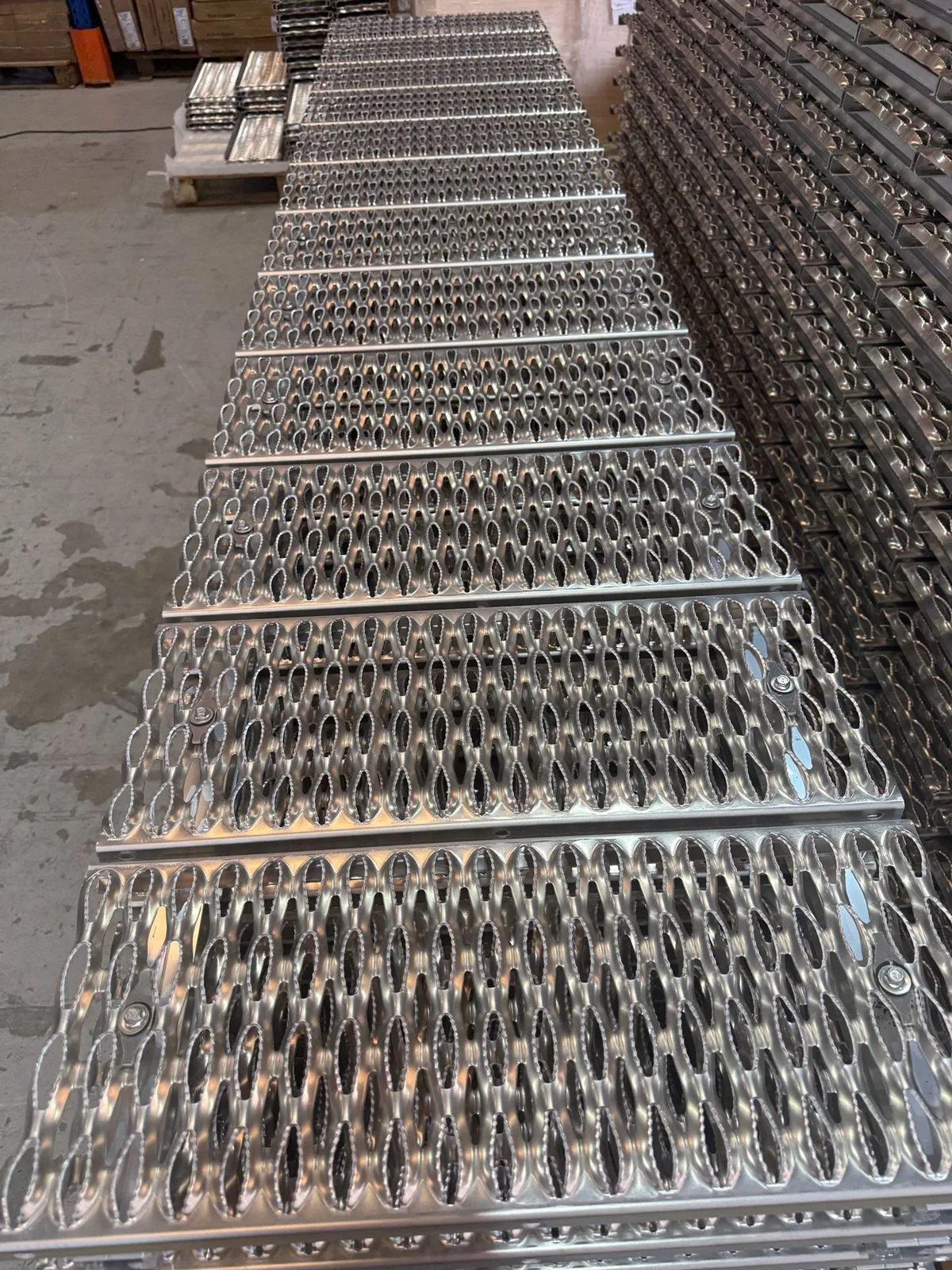

If you're looking to buy fiberglass grating, AMMS Global manufactures and supplies both molded and pultruded FRP grating for industrial, marine, and commercial projects worldwide. We ship from our Coimbatore facility to clients across the Middle East, Africa, Southeast Asia, and beyond, and we work directly with contractors, EPC firms, and distributors who need reliable fiberglass grating suppliers they can order from repeatedly.
Fiberglass grating (also called FRP grating or GRP grating) is made from glass fiber reinforced plastic. Unlike steel or aluminum grating, it doesn't rust or corrode, so it holds up in chemical plants, water treatment facilities, offshore platforms, and anywhere moisture and corrosive chemicals would eat through metal. It's also non-conductive, lightweight, and low maintenance, which is why it's replacing steel grating across a lot of industrial applications.
We currently manufacture two core product lines: FRP Molded Grating and FRP Pultruded Grating. Request a quote and we'll get back to you within 24 hours with pricing.
Our Fiberglass Grating Products
FRP Molded Grating - MG-1½" Bi-directional fiberglass reinforced plastic grating with strong chemical resistance, built for corrosive environments where steel grating would fail within a couple of years.
FRP Pultruded Grating - PG-2" High-strength pultruded FRP grating with greater load capacity than molded panels, suited for longer spans and heavier foot or equipment traffic.
Molded Grating | Pultruded Grating | |
Strength direction | Bi-directional | Unidirectional (stronger along the span) |
Best for | General walkways, platforms, wet/oily areas | Heavy loads, long spans, mezzanines |
Surface | Coarser, high grit | Smooth, uniform bars |
Load capacity | Good for evenly distributed loads | Higher load capacity over distance |
Typical use case | Chemical plants, wastewater, drainage covers | Industrial walkways, high-traffic platforms |
Not sure which one fits your project? Talk to our team and tell us your load requirements and span, and we'll recommend the right grating.
Fiberglass Grating Specifications (General industry reference)
Spec | Typical Range |
Panel size | 1220mm x 3660mm most common globally |
Thickness | 25mm–50mm, with 30mm and 38mm most used industrially |
Mesh size | 38mm x 38mm standard, 25mm x 25mm for finer applications |
Open area | 60–68% |
Weight | Roughly 9–15 kg/m² depending on thickness |
Resin systems | Isophthalic polyester, orthophthalic, vinyl ester |
Surface finish | Gritted top (best slip resistance), meniscus, concave |
Why Choose AMMS Global as Your Fiberglass Grating Manufacturer
Direct manufacturer pricing - you're buying from the source, not a reseller, so pricing stays competitive on bulk and repeat orders.
Export-ready - our team handles international shipping documentation and packaging built for long-distance freight, so damage in transit isn't a concern.
Custom sizing and resin options - we can adjust panel size, mesh spacing, and resin type (polyester, vinyl ester, isophthalic) depending on the chemical exposure in your facility.
Fast quoting - request a quote and expect pricing back within 24 hours, not days.
One supplier for your full grating needs - alongside fiberglass grating, we also manufacture bar grating, expanded metal, perforated metal, and stair treads.
Industries and Applications
Fiberglass grating from AMMS Global is used across:
Chemical processing plants and refineries, where corrosion resistance is non-negotiable
Water and wastewater treatment facilities
Offshore platforms and marine structures
Food and beverage processing plants (non-conductive, easy to clean)
Power substations, where the non-conductive property matters for safety
Cooling towers, walkways, platforms, and trench covers
Frequently Asked Questions
1. What is fiberglass grating?
Fiberglass grating is a composite panel built from fiberglass strands bonded together with resin. It's used as a corrosion resistant, non-conductive alternative to steel or aluminum grating across industrial flooring, walkways and platforms.
2. What is the difference between molded and pultruded fiberglass grating?
Molded fiberglass grating is a single piece panel with a high resin content, which gives it strong bi-directional load capacity and solid chemical resistance. Pultruded fiberglass grating is built from I-beam shaped bars pulled through a resin die, giving it stronger unidirectional strength and better performance across longer spans.
3. Is FRP grating stronger than steel?
Pound for pound, fiberglass grating has a better strength to weight ratio than steel, and it holds onto that strength over time since it isn't fighting corrosion the way steel is. Steel can still out-stiffen FRP under extreme point loads in a small area, but factor in years of corrosion and FRP often wins out on real world service life.
4. How long does fiberglass grating last?
Properly manufactured fiberglass grating typically holds up for 20 to 30 years, even in harsh chemical or marine conditions, simply because it isn't exposed to the rust and corrosion that eventually wears down metal grating.
5. How do you cut and install fiberglass grating?
Fiberglass grating is usually cut with a carbide tipped or diamond blade made for composite materials, which keeps fraying at the cut edge to a minimum. Installation involves fixing panels to the support structure with FRP or stainless steel clips, and any cut edges left exposed should be sealed with resin so the fibers stay protected and the corrosion resistance holds up.
6. Why choose FRP grating over metal grating?
FRP grating doesn't rust, doesn't conduct electricity, and resists most acids, alkalis and salts that would corrode steel or even aluminum over time. It's also considerably lighter, which cuts installation cost. Metal grating still tends to win on raw strength per dollar for heavy vehicular loads, but for corrosive, electrically sensitive or coastal environments, fiberglass grating usually costs less over its working life once maintenance and replacement are factored in.