What Type of Heavy Duty Grating Is Best for US Industrial Facilities
The best heavy duty grating for US industrial facilities is usually welded steel bar grating, with stainless steel, aluminum or FRP chosen for corrosion and weight needs.
The best heavy duty grating for most US industrial facilities is welded steel bar grating with a serrated surface, balancing load capacity, durability, slip resistance, and cost for mezzanines, trench covers, and access platforms. The right choice shifts with corrosion exposure, chemical contact, weight limits, or electrical safety. Materials matter as much as construction method, and the decision usually comes down to steel, stainless steel, aluminum, or fiberglass.
AMMS Global supplies grating to engineers, contractors and procurement teams in more than 40 countries, and the same selection logic applies to US facilities. The most common mistake is specifying grating before fully understanding the environment, leading to premature corrosion, overspending on unnecessary alloys, or unsafe walking surfaces.
Matching Grating Type to the Actual Service Conditions
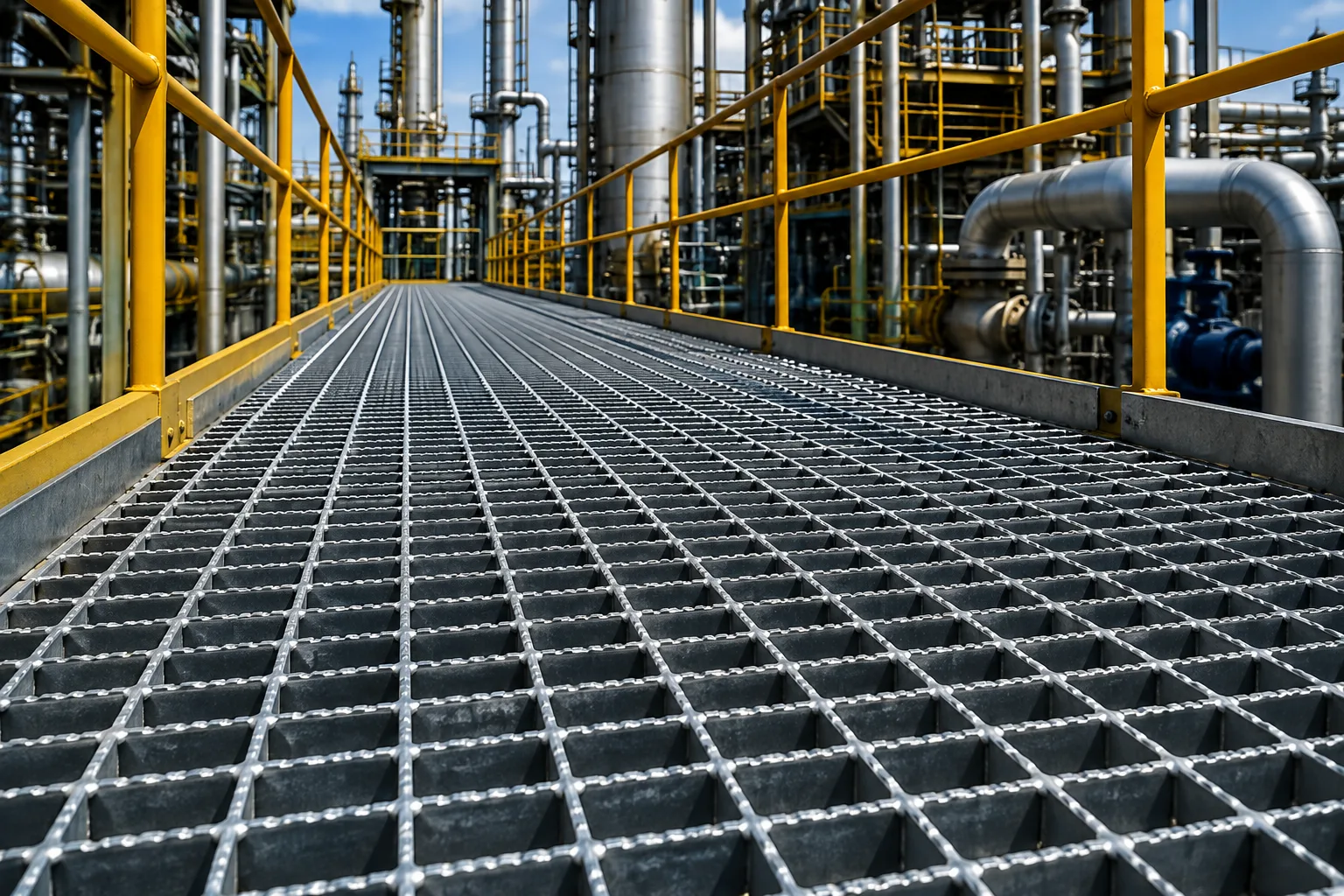
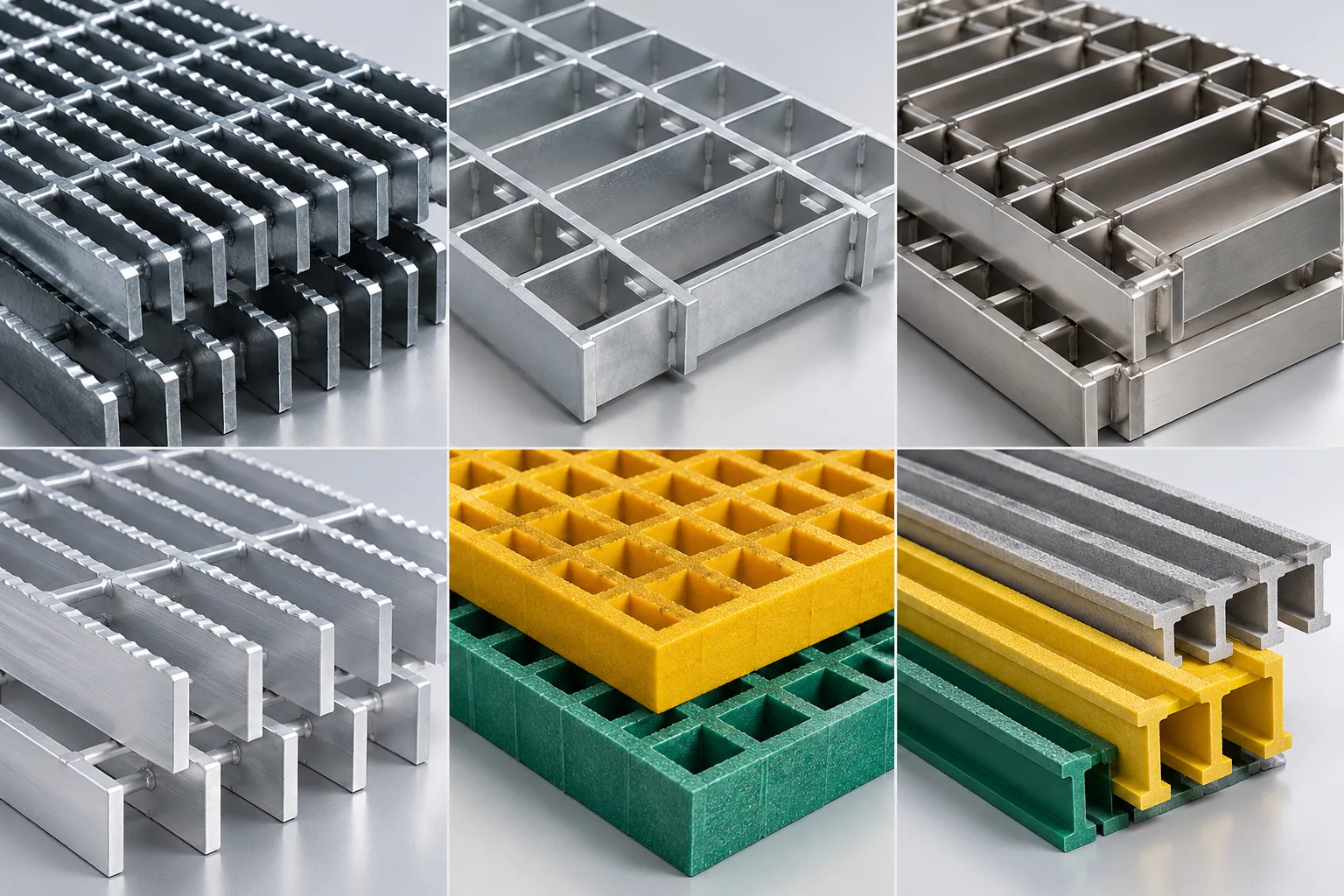
Welded bar grating remains the default for heavy loads. Bearing bars are resistance-welded to cross rods, creating a rigid panel that handles forklift traffic, heavy equipment, and long spans. Bar depth and thickness drive capacity: a 1-1/2 inch by 1/4 inch bearing bar handles moderate industrial loads, while 2 inch, 2-1/2 inch, or deeper bars suit heavier wheel loads or wider spans. Serrated surfaces are standard wherever oil, water, or grease is present.
Press-Locked Grating offers a cleaner appearance and tighter tolerances than welded grating. Cross bars are mechanically locked into pre-punched bearing bars under high pressure, eliminating weld points and producing a smooth, architectural finish. It is common in food processing, pharmaceutical plants, and commercial spaces where strength and appearance both matter.
For corrosive environments, material choice outweighs construction method. Stainless Steel Grating, typically Type 304 or 316, resists chemical attack, washdown, and marine exposure; Type 316 is better near saltwater or chloride-heavy processes. Aluminium Bar Grating is lighter and naturally corrosion-resistant, practical for walkways, access platforms, and reducing structural dead load. It does not match steel for stiffness at the same panel depth, so spans and bar sizes need careful review.
Fiberglass Grating solves problems metal cannot. FRP Molded Grating is cast from resin and continuous fiberglass strands in a mold, producing a one-piece panel with bidirectional strength and excellent corrosion resistance. FRP Pultruded Grating pulls fiberglass rovings through a resin bath into high-strength bearing bars, giving greater span capability in one direction. Both are non-conductive and common in chemical plants, water treatment facilities, and electrical substations. Both types are available from AMMS Global as FRP Molded Grating and FRP Pultruded Grating.
Heavy Duty Options Compared
Grating Type | Best For | Key Strength | Main Limitation |
Welded steel bar grating | Heavy loads, mezzanines, trenches | Highest load capacity, low cost | Corrodes without coating |
Press-locked grating | Architectural, food-grade areas | Clean finish, no weld points | Higher fabrication cost |
Stainless steel grating | Chemical, washdown, marine | Corrosion resistance, strength | Material cost and weight |
Aluminum bar grating | Walkways, access platforms | Lightweight, corrosion-resistant | Lower stiffness than steel |
FRP molded grating | Chemical, electrical, water treatment | Non-conductive, corrosion-proof | Lower stiffness, higher deflection |
FRP pultruded grating | Longer spans in corrosive areas | Directional strength, lighter than steel | Higher initial material cost |
Grip Strut Grating, also called safety grating, is formed from a single sheet of metal with diamond-shaped perforations and serrated edges, providing multidirectional slip resistance without the open area of bar grating. Heavy duty versions use thicker gauge material and are common on catwalks, stair treads, and truck and trailer access points.
What Experienced Buyers Check Before Ordering
Load tables are non-negotiable. Grating deflection under load is often the controlling factor, not ultimate strength; a panel that safely supports a load may still feel bouncy or cause water to pool if deflection is too high. Manufacturers publish load tables for each bar size and span, and those tables should drive the specification.
Open area affects drainage and safety. Bar grating with closer bearing bar spacing, such as 1-3/16 inch or 1-1/4 inch centers, is easier for foot traffic and meets ADA requirements in pedestrian areas. Wider spacing drains faster but can catch heels or wheels.
Fastening is the weak point in many installations. Grating clips, saddle clips, and hold-down fasteners must match the panel type and supporting steel. Loose or incorrectly specified fasteners cause panel shifting, noise, and premature wear.
Fabrication details matter as much as the panel. Cutouts for pipes, toe plates, stair tread nosings, and removable panels affect fit and safety. Custom fabrication is a core part of most heavy duty grating orders, and AMMS Global handles shop fabrication such as cutouts, toe plates and banding before shipping.
Choosing Between Metal and Fiberglass
Metal grating wins when stiffness, impact resistance, and high-temperature tolerance are required. Steel and stainless steel handle direct flame, hot drips, and heavy point loads better than fiberglass. Galvanized steel is economical for outdoor or mildly corrosive conditions, while painted black finishes suit indoor architectural use.
Fiberglass wins when corrosion or electrical conductivity is the primary concern. It never rusts, resists a wide range of chemicals, and does not conduct electricity. The trade-off is deflection: FRP panels typically require closer support spacing than steel at the same load and can be damaged by severe impact or prolonged UV exposure without a UV-stabilized resin.
Common Installation Mistakes
Specifying bar depth without checking deflection tables leads to bouncy, uncomfortable walkways even when the panel is structurally safe. Using standard steel grating in a washdown area causes rust staining within months. Skipping serrated surfaces in outdoor or oily locations creates slip hazards. Choosing FRP for a forklift traffic area without verifying wheel load capacity results in cracked panels. Ordering panels without confirming fabrication details, like cutouts or removable sections, forces expensive field modifications.
For facilities that also use Expanded Metal or Perforated Metal in screens, guards, or infill panels, confirm whether those products meet the same loading and corrosion requirements as the primary grating. Standard Expanded Metal is not a substitute for bar grating in load-bearing applications, but it works well for enclosures and machine guards.
The practical next step is to define the load, span, environment, and traffic type for each location before requesting quotes. A mezzanine with pallet jacks needs different grating than a chemical plant walkway or a trench cover on a loading dock. For trench covers, see our guide on how to choose trench drain grating for US industrial facilities. For footbridges and elevated walkways, read what type of bridge grating is used in the US. Once those conditions are clear, the material and construction choice narrows quickly, and the specification writes itself.