What Are the Different Types of Crowd Control Barriers?
Explore the different types of crowd control barriers, their applications, materials, and key benefits to choose the right barrier for your event, site, or facility.
Crowd control barriers are temporary or semi-permanent physical structures used to guide, contain, and protect people in public spaces, construction sites, and events. They fall into four broad categories: steel interlocking barriers, retractable belt barriers, water-filled or plastic barriers, and expanding barricades. Each type solves a different problem, and choosing the wrong one can create safety risks or unnecessary costs.
AMMS Global supplies a range of steel, aluminium, and expanded metal products used in various fabrication and infrastructure applications, including materials that may be incorporated into crowd control barrier systems. Understanding the differences between barrier types helps fabricators select the appropriate materials for each project.
Barrier Types Compared Side by Side
Barrier Type | Best For | Typical Material | Key Limitation |
Steel interlocking | Concerts, parades, high-density crowds | Galvanised steel | Heavy, needs storage space |
Retractable belt | Queues, indoor lobbies, retail | Aluminium or steel post with fabric belt | Not a physical barrier, only visual guidance |
Water-filled plastic | Roadworks, traffic calming, event perimeters | UV-stabilised polyethylene | Can be punctured, needs filling and draining |
Expanding barricade | Temporary indoor or light outdoor use | Steel or aluminium scissor frame | Low mass, can be pushed over easily |
Steel Crowd Barriers
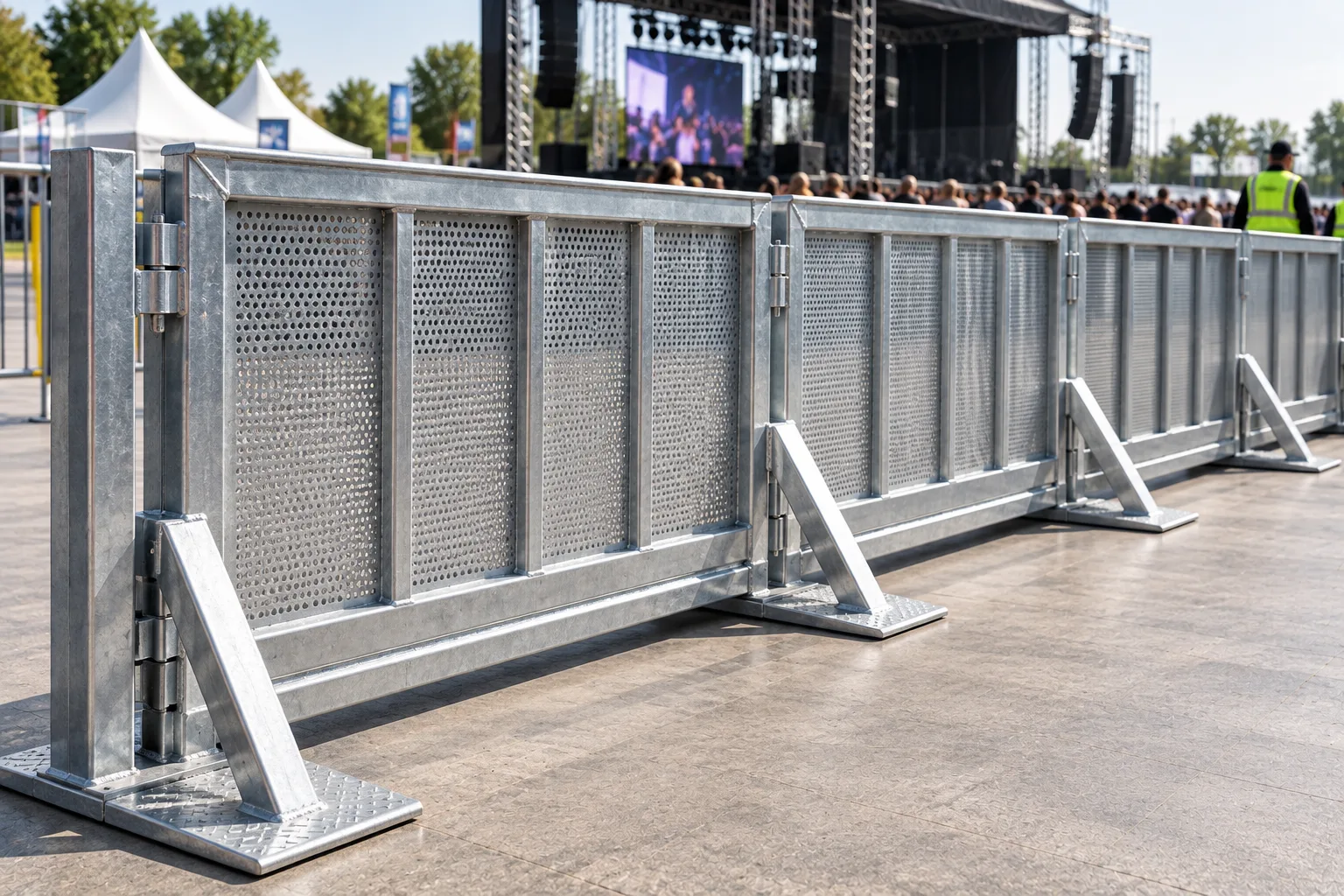
Steel crowd barriers, often called metal crowd barrier systems, are the workhorses of festivals, demonstrations, sporting events, and construction site perimeters. The most common design uses a galvanised steel frame with a hook-and-eye or pin connection at each end, allowing barriers to be linked into continuous runs that resist lateral pressure from a crowd.
What makes heavy duty crowd control barriers different from lighter options is the gauge of the steel tube, the quality of the galvanising, and the stability of the base. A well-made barrier has a low centre of gravity and feet that extend forward so that crowd pressure pushes the barrier down rather than tipping it backward. Cheaper imported barriers sometimes skimp on base plate thickness, which shows up as bending or warping after a few events.
A practical point that event managers learn quickly: interlocking steel barriers perform best when the run is not perfectly straight. Gentle curves and angles distribute force better than a long straight line, which can bow under sustained pressure. Also, barriers should be inspected after each use for cracked welds, especially around the connection points, since that is where fatigue failures start.
Retractable Belt Barriers
Retractable belt barriers, also called stanchions, are what most people see in airports, banks, and hotel lobbies. A post holds a spring-loaded fabric belt that clips into the next post, creating a visible queue line or restricted area.
These are guidance tools, not physical barriers. Anyone can duck under a belt or unclip it, so they are unsuitable for security perimeters or anywhere crowd pressure is expected. Their value is in organising orderly queues and communicating where people should and should not walk. Wall-mounted versions save floor space in narrow corridors, and some posts accept signage panels for directions or safety notices.
When specifying retractable belts, the quality of the spring mechanism matters more than the post finish. A slow-retracting belt that snaps back hard is a safety hazard, particularly around children. Look for damped retraction and belts that lock at the required length without sagging.
Water-Filled and Plastic Barriers
Plastic barriers filled with water or sand serve a different purpose. They are common around roadworks, temporary traffic diversions, and event vehicle routes. Empty, they are light enough for one person to move. Filled, they become substantial enough to redirect a slow-moving vehicle or mark a closed lane.
The trade-off is maintenance. Water-filled barriers need filling before use and draining before transport, which adds labour and time. In freezing conditions, water expands and can split the shell unless an antifreeze additive is used. Some designs are rated to specific impact standards for highway use, while others are only suitable for pedestrian areas, so checking the intended application is essential.
Expanding Barricades
Expanding barricades are scissor-folding frames that open to form a temporary barrier across doorways, maintenance areas, or spill zones. They are quick to deploy and store flat, which makes them popular for facilities teams and retail environments.
Their weakness is stability. Because they are lightweight, they can be knocked over by a strong push or a gust of wind. Some models have interchangeable feet or hook-and-loop ends for linking, but they remain a visual deterrent and trip hazard marker rather than a robust physical block.
How to Choose Without Overbuying
The most common mistake is buying heavy duty crowd control barriers for a job that only needs a visual guide, or using lightweight stanchions where crowd pressure is possible. Start by asking what force the barrier must withstand: a queue of shoppers, a surge of concertgoers, or a vehicle. Then consider storage and transport, since steel barriers consume significant space and weight capacity.
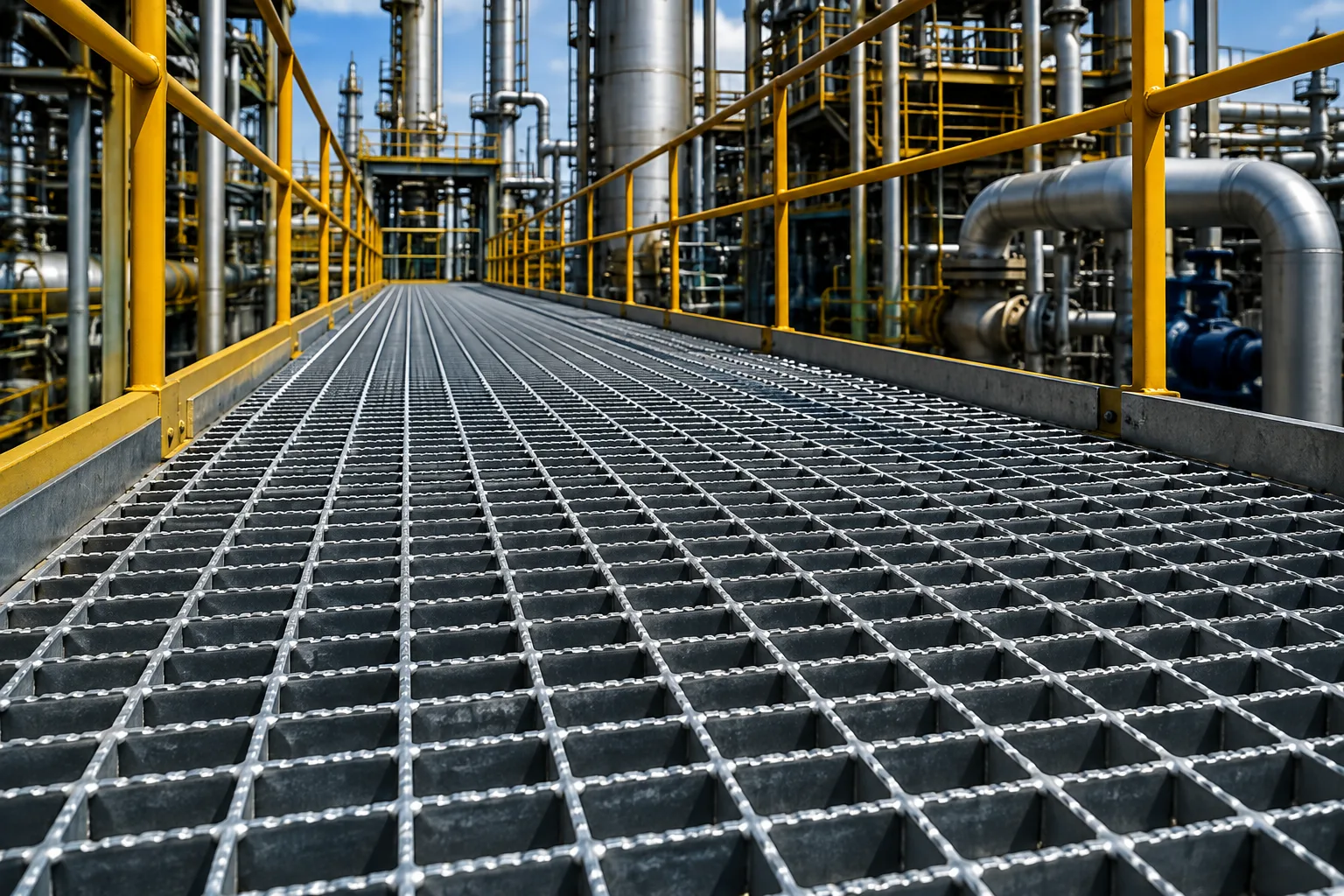
For projects that require related metal and steel products, AMMS Global supplies Bar Grating, Aluminium Bar Grating, Stainless Steel Grating, Expanded Metal, Standard Expanded Metal, and Flattened Expanded Metal. These products are used across a range of industrial, architectural, fabrication, walkway, platform, and site infrastructure applications. Selecting the appropriate material, thickness, finish, and product type according to the project environment can help improve durability, performance, and service life.
If your project requires specific materials, product specifications, or quantities for fabrication and infrastructure applications, get a quote from AMMS Global to discuss your requirements and available options.