What Is Diamond Safety Grating and How Does It Improve Industrial Workplace Safety?
Diamond safety grating is a punch-formed metal plank with raised diamond openings that gives industrial walkways and stairs slip resistance and drainage.
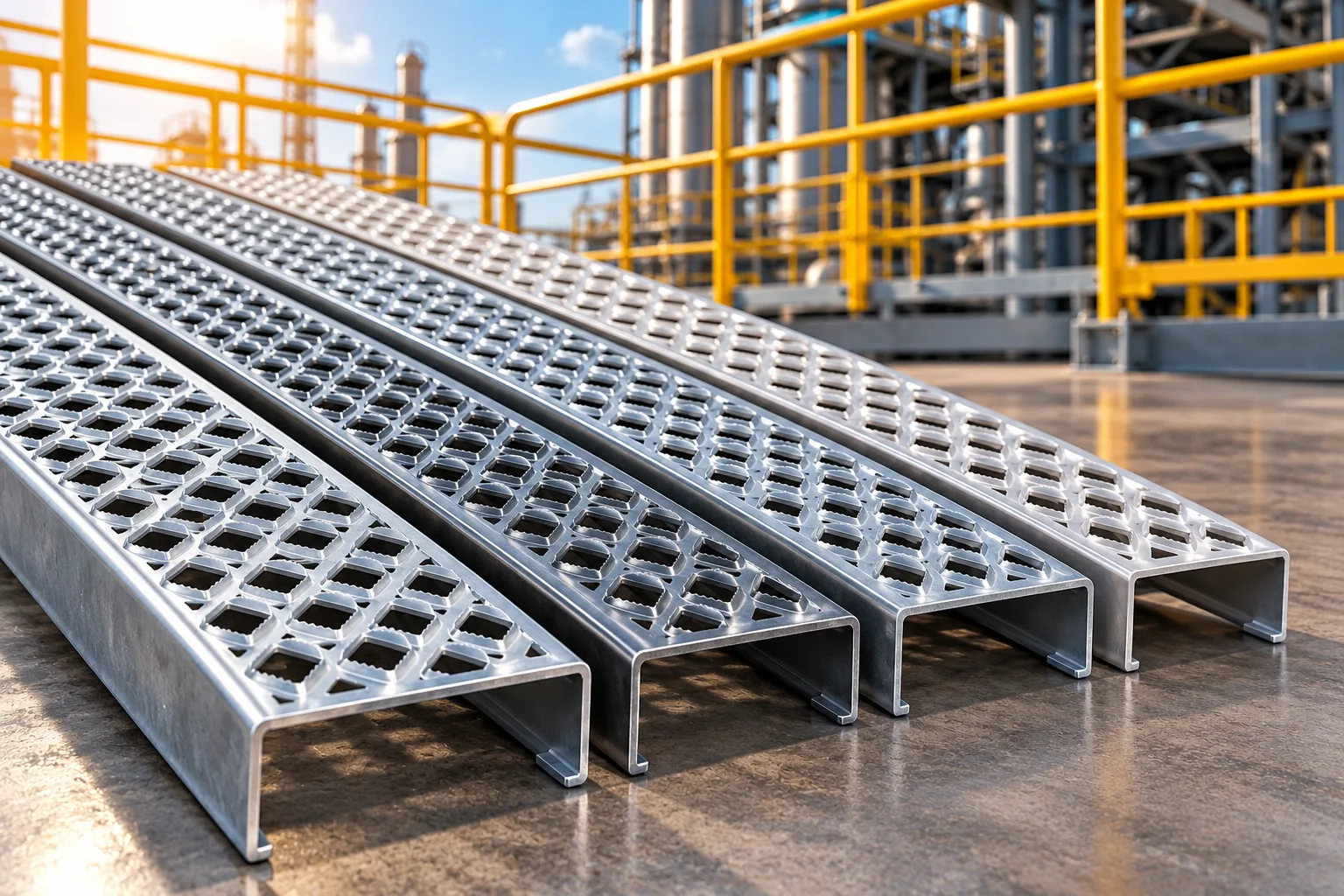
Diamond safety grating is a punch-formed metal plank with raised diamond-shaped openings creating a slip-resistant walking surface for industrial walkways, platforms, catwalks and stair treads. The open diamond pattern lets fluids, grease, mud, ice and debris drain through rather than pool, making it practical where solid flooring becomes hazardous. AMM Solutions supplies and fabricates this grating alongside related products for industrial and commercial applications.
The diamond openings are punched and raised from the base metal itself, creating a permanent mechanical grip that does not wear away like paint-on anti-slip treatments. The raised edges around each opening bite into shoe soles in wet, oily or icy conditions.
What the Surface Pattern Actually Does
The diamond pattern provides traction in multiple directions, allows drainage so water and oil do not sit on the surface, and helps debris fall through rather than build up underfoot.
The pattern is available with serrated or smooth edges. Serrated edges give more aggressive grip and are specified for outdoor ramps, loading areas and places exposed to ice or heavy oil. Smooth edges are easier to clean and often chosen for food processing or areas where workers may kneel or place gloved hands on the surface.
Material and Size Options
Diamond safety grating is manufactured in carbon steel, pre-galvanized steel, stainless steel and aluminum. The choice depends on environment more than load.
Material | Best Suited For | Key Trade-Off |
Carbon steel | Indoor platforms, mezzanines, dry industrial areas | Lowest material cost; needs paint or galvanizing for corrosion resistance |
Pre-galvanized steel | Outdoor walkways, washdown areas, general exterior use | Good corrosion resistance; cut edges may need touch-up coating |
Stainless steel | Food plants, chemical processing, marine environments | Excellent corrosion resistance; heavier and more expensive than carbon steel |
Aluminum | Roof walkways, portable ramps, areas needing light weight | Naturally corrosion-resistant; lower strength than steel at the same thickness |
Plank widths range from narrow single-diamond profiles to wider multi-diamond planks, commonly described by diamonds across the width: 1-diamond, 3-diamond, 5-diamond or 8-diamond planks. Channel depths vary, commonly around 1-1/2 inches, 2 inches and 2-1/2 inches. Material thickness typically falls between 8 and 14 gauge, or roughly .080 to .100 inch for some profiles.
Diamond Grip vs Grip Strut: What Is the Difference
Diamond grip safety grating and Grip Strut Grating share the same basic concept: a channel-shaped plank with punched openings. AMMS Global supplies it as Grip Strut Safety Grating Tread, and the terms diamond grip safety grating and grip strut are often used interchangeably. Both rely on raised perforations for slip resistance and drainage.
The practical difference is specific dimensions, edge treatment and availability. A 5-diamond plank at 3 inches deep with .080 inch thickness may be available from one manufacturer, while another offers an 8-diamond plank at 2-1/2 inches deep in .100 inch thickness. Specifying by dimensions rather than brand name usually gives more flexibility.
Some refer to diamond metal grate or diamond grates when they mean this product, though those terms can also describe expanded or perforated metal with diamond-shaped openings. Confirm the exact profile, depth and material before ordering.
Where It Works Well, and Where It Does Not
Diamond safety grating works best where drainage and slip resistance matter more than a completely smooth surface. Common uses include mezzanine walkways, equipment access platforms, crossover bridges, stair treads and ladder rung covers.
The raised diamond pattern is not comfortable for prolonged standing in one spot, so it is less suitable for fixed workstation floors where workers stand for hours. The openings can catch small wheels on carts or dollies. Where tiny parts or tools could fall through and create a hazard below, a tighter pattern or solid Floor Grating may be better.
For stair applications, diamond safety grating is often fabricated into Stair Treads or used as a Grip Strut Safety Grating Tread. A Serrated Safety Stair Tread gives extra grip at the leading edge, where most slips happen.
How It Compares to Other Grating Types
Diamond safety grating is one option among several. Bar Grating, including Welded Bar Grating and Press-Locked Grating, uses load-bearing bars with cross rods and offers high strength-to-weight ratios for long spans. Aluminium Bar Grating and Stainless Steel Grating provide corrosion resistance in bar form. Fiberglass Grating, including FRP Molded Grating and FRP Pultruded Grating, suits corrosive environments and electrical safety applications. Expanded Metal and Standard Expanded Metal use a different manufacturing process that stretches sheet metal into a mesh. Perforated Metal has punched holes in a solid sheet. Platform Grating is a broader category that includes several of these types.
The main advantage of diamond safety grating over bar grating is the channel-shaped plank design, which can span short to medium distances without additional support and provides a continuous walking surface with built-in drainage. Bar grating often allows more light and air passage, but the plank design can feel more solid underfoot.
Practical Considerations Before Ordering
Cut edge treatment is easy to overlook. When planks are cut to length, the cut ends lose whatever protective coating was applied. Pre-galvanized planks, in particular, need cut ends sealed or touched up to maintain corrosion resistance.
Fastening matters too. Diamond safety grating planks are typically secured with saddle clips, hold-down clips or direct bolting. The fastening method affects how the plank performs under load and how easily it can be removed for access below.
Load span is also worth checking. The channel depth and material thickness determine how far a plank can span between supports without excessive deflection. A deeper channel generally allows a longer span, but adds weight and height.
For ordering, specify the material, finish, plank width, channel depth, thickness and whether the surface is serrated or smooth. Confirm exact dimensions with the supplier, since nominal sizes can vary between manufacturers. AMM Solutions can help with material selection and fabrication when the application is not a straightforward stock item.